
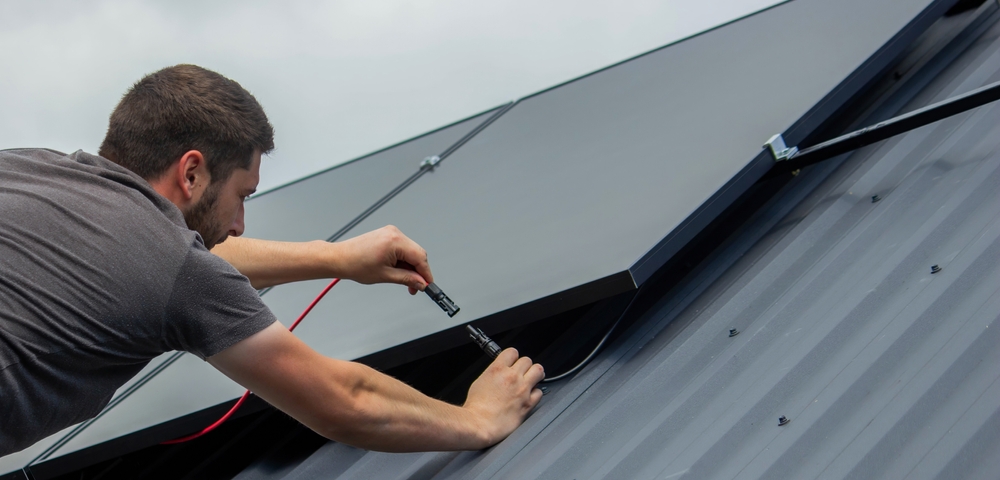
Both metal roofing and solar panels are growing in popularity in Tennessee, leading many to wonder if you can put solar panels on a metal roof. Not only can you, but there can be measurable energy and durability advantages of metal roofing and solar integration.
That said, some metal roofing systems are better suited for solar panels than others. There are also other important considerations, such as proper mounting hardware, cost, aligning your metal roof’s lifespan with solar installation cycles, and properly coordinating all parties involved to ensure a watertight, code-compliant installation that holds up for the life of both systems.
In this article, the metal roofing experts at Metal Formers Inc. explain everything you need to know before installing solar panels on a metal roof.
Installing Solar Panels on a Metal Roof: Pros, Cons, and Important Considerations
There are demonstrated performance and financial benefits to installing a metal roof with solar panels, but there are also downsides, such as upfront costs and the need to coordinate suppliers and installers across both scopes of work.
A successful metal roof and solar installation also involves timing decisions that can affect the outcome of both installations.
Aligning Roof Lifespan with Solar Installation Cycles
When planning a solar installation, one of the most important factors to consider is whether your roof will outlast the solar system. If your roof needs to be replaced before the solar system reaches the end of its useful life, you risk paying thousands in labor costs to remove and reinstall the panels.
With a new metal roof, that concern largely disappears. A quality metal roof lasts 40 to 70 years. A standard solar panel system lasts 25 to 30 years, meaning a well-maintained metal roof can realistically support two consecutive generations of solar panels without a structural roof replacement in between.
If you have an older metal roof, you can still install solar panels, but you will need to weigh the pros and cons of timing your solar installation against your roof’s remaining lifespan.
- If your metal roof has at least 30 years of life remaining, it will still easily outlive the solar panels, so you can proceed with installation without incurring additional labor costs.
- If your roof has 15 years or less remaining, replacing it before installing solar is typically the smarter move. Otherwise, you risk paying thousands in labor costs to remove the solar system just to replace the roof beneath it.
- If your roof falls somewhere in between, a professional assessment of its condition is the right call before committing either way.
If you have an older exposed-fastener or screw-down metal roof, another consideration is the condition of the washers. These systems use rubber washers around the fasteners that typically degrade after 15 to 20 years. If you want to install solar on an existing metal roof near or within that window, the washers will likely need to be replaced before the solar panels can be anchored overhead.
Non-Penetrating S-5! Clamps for Watertight Integrity
Most roofs require drilling to attach solar hardware. Even with sealant, those penetrations can create potential points of water intrusion. Standing seam roofs use non-penetrating, drill-free S-5! clamps that eliminate those risks.
The clamps attach directly to the raised seam using setscrews that grip the metal without piercing it, leaving the roof surface completely intact and the manufacturer’s warranty valid. When the solar system eventually reaches the end of its lifespan, the clamps unbolt cleanly, leaving the metal roof completely undisturbed and ready for the next installation.
Synergy: Reflective Roofing and Bifacial Solar Panels
Bifacial solar panels are solar modules that capture sunlight on both the front and rear faces. The front captures direct sunlight while the rear side collects light reflected off the surface beneath the panels, resulting in more electricity than standard single-sided panels can generate from the same footprint.
Light colored metal roofing reflects more light than darker roofing surfaces. When bifacial panels are paired with a reflective metal roof, the roof actively feeds the rear-side cells, amplifying the output advantage they already have. The degree of that benefit depends on mounting height and tilt.
That synergy boosts the solar energy the system yields while simultaneously lowering cooling costs, reducing energy bills, and translating to a faster return on investment than either would deliver on a less compatible roof surface.
Navigating Financial Incentives for Combined Projects
Despite substantial long-term savings, for many, one disadvantage of metal roofing and solar integration is the upfront cost. Fortunately, there are tax credits and programs you and your builder may qualify for that can help reduce expenses.
Below are a few of the most well-known incentive programs in Tennessee, broken down by residential, commercial, and agricultural sectors, that are either currently active at the time this article was written or are still commonly discussed but have expired. As with any incentive program, eligibility, rates, and availability change. For accurate information, discuss current options with a tax professional.
Residential Incentives
Section 25D Federal Solar Tax Credit
One of the most well-known financial incentives for solar is the federal residential solar tax credit, which allows qualified homeowners to claim 30% of solar installation costs. Unfortunately, it expired for residential projects on December 31, 2025.
Solar Leases and Power Purchase Agreements (PPAs)
Solar leases and PPAs are third-party ownership arrangements that allow homeowners to benefit from solar without purchasing the system outright. Because the solar company owns the system rather than the homeowner, it can claim the commercial Section 48E credit and pass the savings to the homeowner through lower monthly payments or reduced energy rates. To qualify, systems under this structure must be fully operational by December 31, 2027.
Tennessee Green Energy Property Tax Assessment
Tennessee’s Green Energy Property Tax Assessment is an active state program where homeowners pay property taxes on only 12.5% of the value a solar system adds to the home. While this does not lower your upfront installation costs, it protects against a significant spike in local property taxes after installation.
TVA Dispersed Power Production (DPP) Program
Some states offer net metering, a billing arrangement that credits solar owners for excess electricity sent back to the grid at the full retail rate. Tennessee does not have traditional retail-rate net metering.
Instead, the Tennessee Valley Authority (TVA) operates a Dispersed Power Production (DPP) program that allows qualifying customers to receive credit for excess energy returned to the grid, though at a significantly lower avoided-cost rate rather than full retail. This incentive doesn’t reduce the initial cost of installing solar, but it can help offset ongoing energy costs over time.
Section 45L Energy Efficient Home Credit
If you are a builder with a qualifying new construction project where the home was acquired by the homeowner before June 30, 2026, contact a tax professional. You may be eligible for the Section 45L energy-efficient home credit, an incentive that offers up to $5,000 for qualifying new energy-efficient home construction.
Commercial and Agricultural Incentives
Section 48E Clean Electricity Investment Tax Credit
The Clean Electricity Investment Tax Credit provides a 30% credit on qualifying solar installation costs, but to qualify, your commercial project must be fully operational and placed in service by December 31, 2027. Note that qualifying projects must also comply with Foreign Entity of Concern rules regarding where solar components are manufactured. Consult a tax professional to confirm eligibility.
Section 179D Commercial Building Deduction
If construction on your commercial project began before June 30, 2026, consult a tax professional about potential eligibility for the Section 179D deduction. This incentive covered qualifying energy-efficient systems, including metal roofing materials that reduce HVAC loads, but it expired for properties that began construction after that date.
MACRS Accelerated Depreciation
As of the time this article was written, commercial properties can take advantage of MACRS accelerated depreciation, which allows solar equipment costs to be recovered over a five-year schedule and can significantly reduce tax liability in the first years of operation.
The bonus depreciation component that works alongside MACRS has stepped down to 20% in 2026 from higher rates in prior years, but the program remains active to date and is one of the more stable commercial incentives currently available.
USDA Rural Energy for America Program (REAP)
Agricultural producers and rural small businesses may qualify for the USDA Rural Energy for America Program, which provides significant grant funding and loans to help offset eligible solar installation costs. For qualifying projects in Middle Tennessee’s rural and agricultural sectors, REAP is among the most substantial incentives currently available.
The Importance of Professional Multi-Trade Coordination
Something to consider when planning metal roofing and solar integration is that installation involves multiple parties, including a metal panel fabricator and supplier, a metal roofing contractor, a solar installer, and, depending on project scope, a structural engineer and licensed electrician.
Each professional must work together for the installation to perform as intended. When all parties are not aligned, it can lead to problems such as solar installers selecting hardware that does not fit the specific metal roof profile, roofing crews installing panels without accounting for the solar array layout, or crew members drilling into the roof surface in a way that compromises the non-penetrating integrity of the system.
A roofing contractor and solar installer must communicate before either scope begins, agreeing on panel layout, attachment hardware, seam spacing, and load distribution requirements. An experienced metal roofing supplier should also be part of that conversation. Sourcing the right panels, accessories, and mounting-compatible components from the start is faster and more reliable than solving fit problems after installation is underway.
Metal Roofing and Solar Frequently Asked Questions
What roof is best for solar panels?
Standing seam metal roofing is widely considered the best roofing surface for solar because it allows panels to be mounted without penetrating the roof, preserving the roof’s watertight integrity and the manufacturer’s warranty. Its 40 to 70-year service life also means it will outlast the solar system, eliminating the cost of removing and reinstalling panels for a roof replacement.
What are the best types of solar panels for metal roofs?
Standard monofacial panels work well on metal roofs, but bifacial panels can increase energy output by capturing light reflected from the metal surface beneath them. The degree of benefit depends on mounting height, tilt, and roof finish, so this is worth discussing with your solar installer during system design.
Is my roof good for solar panels?
Most structurally sound roofs can support solar panels, but the type of roofing material significantly affects the installation method, long-term performance, and total system cost. If you’re considering solar panels, it’s best to consult with a qualified roofing contractor before moving forward.
How does metal roofing with solar shielding compare to traditional roofing?
On a metal roof, solar panels provide incidental protection to the surface beneath them, further extending an already long service life. For traditional roofing materials, the shielding benefit exists but matters less, as the roof will likely still need replacement before the solar system reaches the end of its useful life.
What are the benefits of installing solar panels on flat metal roofs?
Flat metal roofs are common in commercial construction and allow solar arrays to be mounted on angled racking systems at an optimal tilt for maximum energy production, regardless of building orientation. The large unobstructed surface area typical of commercial flat roofs also allows for more panels and higher total system capacity than most sloped roofs can accommodate.
Energy Roofing and Solar Solutions in Middle Tennessee
Metal Formers, Inc. manufactures standing seam metal panels and supplies the roofing accessories needed for a solar-ready installation. Our panels are custom-fabricated in-house at our Mt. Juliet facility, with fast turnaround for contractors, homeowners, and commercial building owners across Middle Tennessee.
If you are planning a metal roofing project with solar in mind, or sourcing materials for a combined installation, contact our team to discuss custom fabrication, compatible panel options, or metal roofing accessories.




Leave A Comment